Prioritizing Diversity in Clinical Trials: An AMWA 2025 Reflection
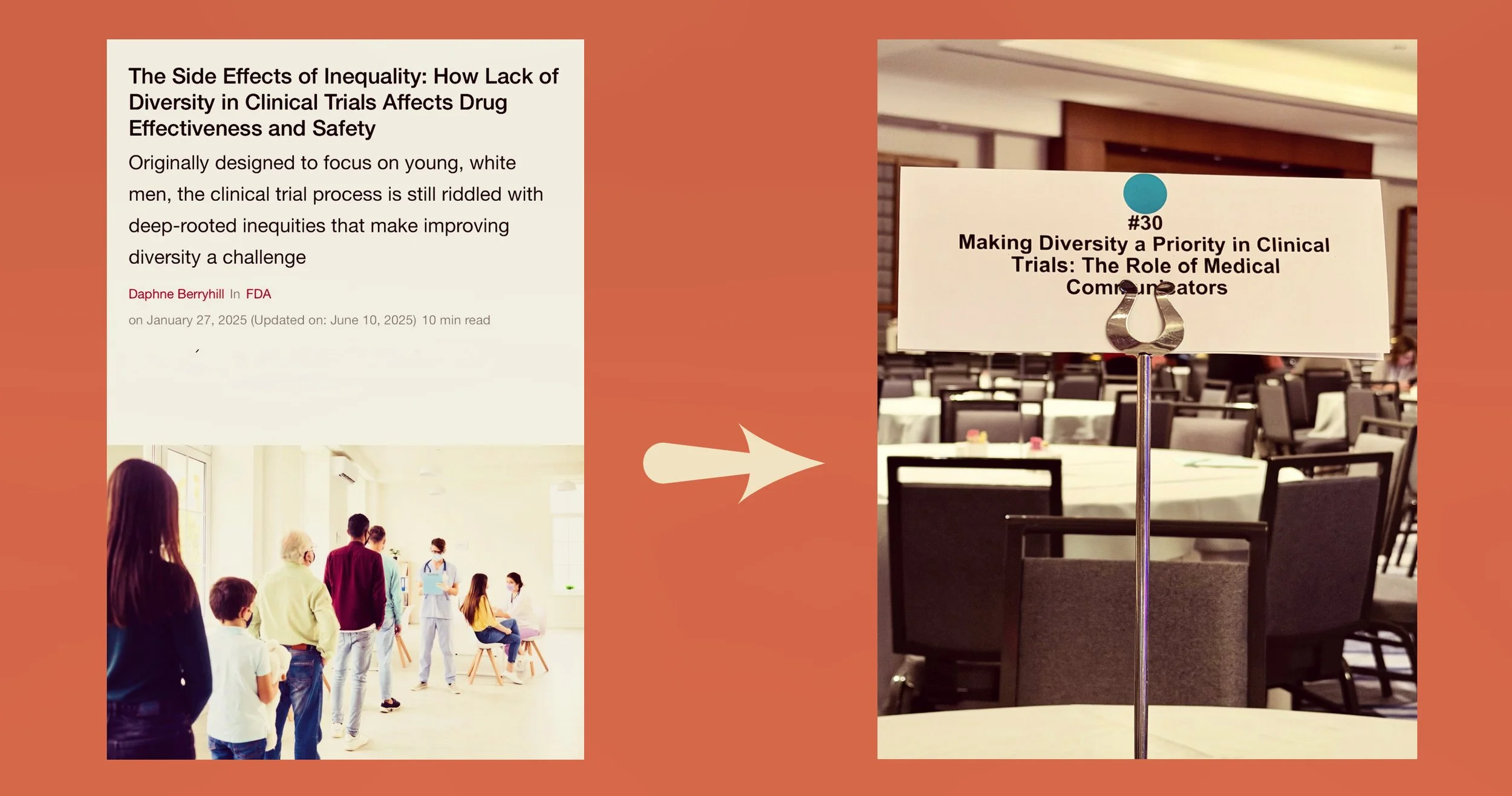
Earlier this year, I wrote a reported piece for the MedShadow Foundation: “The Side Effects of Inequality: How Lack of Diversity in Clinical Trials Affects Drug Effectiveness and Safety.” Those conversations and research left me asking: How can I, as a writer, prioritize diversity and inclusion in clinical research? AMWA’s annual conference felt like the perfect place to discuss these questions with others in the medical writing community. My roundtable topic centered on the role medical communicators have in prioritizing diversity and inclusion in clinical trials.
In this newsletter, I’m sharing insights from conversations and sessions I attended at AMWA 2025 in Phoenix. It was a joy to learn from and connect with so many medical writers. I left feeling awe-inspired and energized to dig in and learn more.
TL/DR: Even when our impact as medical writers is limited by the scope of our work, we should consistently look for opportunities to highlight diversity and inclusion—whether by advocating for broader recruitment, transparent and contextualized reporting, or more inclusive communication. Speak up, share your perspective, and encourage others to do the same. We can make a difference to help ensure equitable access to medical care!
Why Medical Writers Matter
As medical communicators, we hold unique power. We help shape protocols, summarize clinical findings, and translate evidence for diverse audiences. We educate healthcare professionals and the public. We understand—at our core—why diversity and inclusion in research matter. And as the AMWA July 2024 blog put it:
“Medical writers are well-positioned to help ensure that clinical trials are designed, implemented, and reported with DEI principles in mind.”
We aren’t just content experts—we’re context experts. Angela Winnier, Robin Whitsell, and Tatyana Wanderer shared this important reminder in their session on why medical writers need a business mindset too, urging us to look up from our keyboards, expand our awareness of what’s happening in the wider world, and watch for navigational clues about where we can have the most impact.
Understanding who participates in research and who is left out is crucial context for expanding the process and helping ensure that the benefits of new treatments reach everyone who needs them.
Context & Representation
Meaningful diversity means more than checking boxes. Diversity in clinical trials goes beyond demographics to include:
Age and biological sex
Genetics and ancestry
Gender and sexual orientation
Pregnancy or lactation status
Socioeconomic factors
Disabilities and comorbidities
Life experiences
Environmental exposures
Health-impacting behaviors
Cultural, spiritual, or traditional beliefs
Local or regional standards or care
Advancing Diversity & Inclusion
Dr. Rafael Veintimilla, M.D., senior director of Clinical Trials Integration and Medical Science Liaison at the University of Wisconsin Clinical Trials Institute, explained this when I interviewed him for MedShadow:
“There have been serious ethical violations in research, particularly against vulnerable populations and those who put trust in researchers only to have their rights violated.”
The grievous history still shapes research today, because every new discovery is built on earlier work. Watch for its implications in places where it is overlooked or omitted, and state the facts when relevant. I recently encountered this firsthand while writing about cosmeceuticals for MedShadow’s Meet Me at the Medcart Substack newsletter. Leah Carroll, the newsletter editor, will share a future explanatory post about the disturbing information regarding the scientist who coined the term.
Regulatory Momentum: Diversity & Inclusion in Trials
The Food and Drug Administration’s Diversity Action Plan seeks to match trial populations to real-world users. Other regional regulatory bodies, such as the European Medical Agency in Europe, have implemented similar guidance.
The International Council for Harmonization's E6(R3) guidelines, adopted earlier this year, are helping to globalize standards that promote equitable access, improved trial design, and transparent reporting of diversity in clinical research.
Still, achieving true inclusion and meaningful diversity remains a challenge in practice. Without broad participation, drugs may work less effectively or less safely in underrepresented groups, deepening disparities and undermining public trust.

The American Medical Writers Association’s annual conference took place at the Sheraton in Phoenix, AZ.
Patient-Centric Approaches
Attending Dr. Simin Takidar’s session, “Patient-powered Perspectives for Regulatory Medical Writers,” reinforced a powerful truth: Engaging patients throughout a drug’s lifecycle is essential for prioritizing diversity in clinical research. Designing trials that accurately reflect the patient population can help ensure more meaningful inclusion and more equitable use once a drug reaches the market.
Physician key opinion leaders who help shape the clinical trial hypothesis may not be fully attuned to what patients need to truly feel better. Dr. Takidar urged writers to imagine clinical trial participation from the patient’s point of view—raising questions at every stage.
No single approach is enough for engaging patients. Instead, Dr. Takidar highlighted the value of persistent curiosity and adaptability. And then, she stressed consistency: “We engage early, we engage often, and we engage right to the very end and beyond.”
Simple, thoughtful questions can sometimes prompt changes that remove unnecessary burdens—such as prolonged fasting, extended driving restrictions, or invasive testing, examples Dr. Takidar noted. While these protocols may make scientific sense, they often create hidden barriers for participants, undermining recruitment and retention. Looser, patient-friendly rules allow trials to reflect real-world conditions, making treatments more accessible and equitable after approval.
Incorporating patients’ voices throughout research helps ensure treatments serve those who need them most.
Six Strategies to Advance Inclusivity
Here are six strategies Dr. Takidar discussed to advance inclusivity in trial design:
Reduce trial barriers: Streamline protocols to enable participation from a diverse range of patients and support strong recruitment.
Expand endpoints: Define outcomes that truly matter to patient quality of life.
Rethink data collection: Diversifying enrollment is only the first step. Data collection should evolve to incorporate cultural literacy and blend quantitative with qualitative methods, capturing patient experiences authentically. To be recognized as evidence by regulators, the data must be collected in a systematic way.
Personalize educational materials: Develop targeted, respectful, and impactful resources that center on people from diverse backgrounds, grounded in health literacy and cultural competence.
Engage communities: Meet people where they’re at, but first, Dr. Takidar stresses learning as much as you can about their culture and perspective before starting the conversation.
Make a business case: Patient engagement requires investment, but leads to better recruitment, higher launch success, and may also reveal what patients really need for future drug development.
Early Inclusion Impact
Phase 3 studies often receive the most attention—and for good reason. They’re pivotal in determining whether a drug is approved, and their results inform prescribing information. Still, when early-phase trials lack diversity, subsequent dose selections may fail to reflect all patient populations.
During her session on creating pharmacometric reports, Dr. Kristen Howery highlighted how phase 1 pharmacometric modeling influences downstream dose-selection decisions. By examining pharmacokinetic and pharmacodynamic variability across subpopulations, researchers can identify genetic, physiological, and environmental factors that influence drug response. When early trials miss some groups, these unrecognized sources of variability may translate into real-world differences in effectiveness and safety.
The Power of Reporting with Nuance
Medical writers are often the gatekeepers of accuracy, nuance, and ethical principles. In the “Writing About Efficacy in Oncology” session, Justin McLaughlin and Dr. Virginia Kelly emphasized careful language—especially around cross-trial comparisons. Even details like seasonality can affect outcomes. When we stop and think before jumping in and writing, we can ask some critical questions about the assignment itself. That same critical eye matters when reporting diversity data.
Five Strategies for Medical Writers
Report the basics: Always include participant demographics and study locations.
Compare: Are participant backgrounds aligned with real-world patient populations—or are key groups missing?
Highlight limits: Flag the inclusion/exclusion criteria that affect generalizability of findings.
Spotlight supportive measures: Note when studies provide resources (like home monitoring equipment or extra counseling) not widely available outside the trial.
Advocate in editing: When word count is tight, push to keep essential diversity data and places where information is missing.
Growing Challenges
Globalized clinical trials add complexity. Writers at the conference working within large clinical trials spread over continents noted that their contributions are often too narrowly focused to influence diversity and inclusion in a broader context. Assessing diversity also presents challenges: achieving diversity goals in one regional population isn’t necessarily accomplished simply by enrolling participants from those groups abroad—cultural, social, and healthcare context matters.
Improved diagnostics are leading to the identification of more rare diseases, but finding effective treatments still lags far behind. Writers working in rare disease spaces noted that diversity measures in these trials are especially difficult to achieve, given that recruitment is already challenged by the small pool of eligible participants.
Medical writers can help clarify these realities and avoid overgeneralizing findings.
Are you connected with Shellianne Booth? I had the privilege to connect and learn about her role at CISCRP—the Center For Info & Study on Clinical Research Participation.

My Closing Reflections
Diversity in clinical research isn’t a box to check—it’s a core element of scientific integrity and health equity. At AMWA 2025, I was inspired by colleagues who share a commitment to more inclusive, meaningful research and communication. As medical writers, we don’t just report clinical science. We can impact who benefits from the research and provide an important check and balance to ensure transparency and accountability.
Prioritizing diversity as medical writers also means we must champion it within our own professional community. The researchers I spoke to for the MedShadow piece also pointed out that if we want to expand clinical research, we need a more diversified research workforce. Of course, the same applies here.
The pipeline and paths into medical writing are often hidden, narrow, and overly burdensome, making it difficult for people from underrepresented backgrounds to access opportunities and advance in the field.
How can we expand pathways into medical writing to bring more voices to the table?
How can we expand opportunities and create a culture where people from different backgrounds, cultures, and life experiences feel more welcomed, included, and supported in their medical writing careers?
How can we communicate that growing a bigger tent of medical writers isn’t just a nice thing to do, but is essential for creating impactful deliverables, urgent for more inclusive science, and beneficial for everyone because it opens space to learn from many voices.
Ultimately, without a purposeful commitment to inclusion at every stage of the research process, scientific advances will continue to fall short of serving those most in need.
As Clyde W. Yancy, M.D., vice dean of Diversity and Inclusion and Chief of Cardiology in the Department of Medicine at Northwestern’s Feinberg School of Medicine in Chicago, told me in an interview for MedShadow:
“This is not a political issue. It’s not even a social issue. It’s a people issue. Folks want to get good care. They want to know that the treatment that we prescribe will work in them.”
Let’s keep the conversation going! If you have insights, questions, or challenges, I’d love to connect. Feel free to email me at daphnebberryhill@gmail.com or reach out on LinkedIn.
Daphne Berryhill, RPh
Clinical Pharmacist & Medical Writer